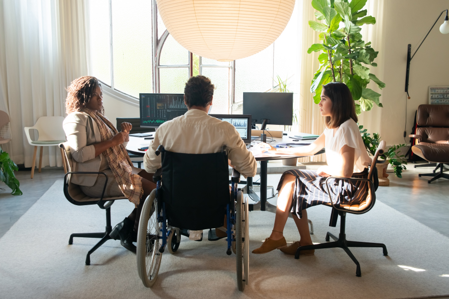
Living Well in the Community brings people together to exchange ideas, develop skills, and support one another’s journey toward greater independence. Stock photo by Kampus Production via Pexels.
What does independent living look like in everyday life?
Sometimes it looks like learning a new skill. Sometimes it starts with a conversation, a shared challenge, or realizing others have faced similar barriers. It can also mean developing the confidence to make decisions, advocate for yourself, improve your health, and participate more fully in your community.
These ideas were at the heart of LIFTT’s work with the Montana Disability and Health Program during the program year that ran from August 1, 2025, through July 31, 2026.
Living Well in the Community
One of the year’s central activities was Living Well in the Community, commonly known as LWC. This peer-led program helps people with disabilities explore practical ways to strengthen their health, independence, self-advocacy, problem-solving abilities, and connection with the community.
LIFTT’s trained LWC facilitators, Pam Ramirez, IL Program Manager, Tanya Thomas, Peer Program Coordinator, and Rachial Combs, former IL Specialist, did much more than present information. They created opportunities for participants to learn from one another, identify personal goals, exchange ideas, and recognize their own strengths.
The facilitators also participated in the LWC Rendezvous and bi-monthly facilitator calls. These gatherings connected them with facilitators from other communities, allowing them to share successes, discuss challenges, discover new activities, and learn strategies for engaging people with different experiences, needs, and learning styles.
In other words, the facilitators were learning while they were helping others learn—and everyone benefited from that exchange.
A Small Group with Growing Energy
LIFTT’s fall Living Well workshop began at the Billings office on September 11, 2025, with two participants. As the sessions continued, something encouraging happened: the group grew.
By the third session, four people were participating. All four remained involved through the final session and celebrated their graduation on November 20.
The numbers may appear small, but each one represents a person. Each participant brought personal experiences, questions, challenges, abilities, and goals into the room. Completing the workshop reflected more than attendance; it represented commitment, perseverance, and a willingness to invest in greater independence.
The fall workshop also demonstrated an important lesson: meaningful programs do not always need a large audience to produce a real impact. A small, engaged group can create a supportive environment in which people feel comfortable participating, sharing, and growing together.
When the Second Workshop Did Not Go as Planned
A second Living Well workshop began on May 12, 2026, with three participants. This time, attendance became inconsistent. One participant withdrew early, another missed too many sessions to qualify for a certificate, and the third did not attend the final sessions. Consequently, the workshop did not conclude with graduation.
Although this was disappointing, it was also educational.
Independent Living programs serve people whose lives may be affected by transportation difficulties, health concerns, personal-care needs, housing instability, changing schedules, and many other barriers. Inconsistent attendance does not necessarily mean that participants lacked interest or motivation. It can remind us that making a program available is only the beginning; we must also consider what people need to participate consistently.
The experience will help LIFTT think more carefully about scheduling, communication, transportation, participant follow-up, accessibility, and other forms of support when planning future workshops.
Accessibility Requires More Than Good Intentions
LIFTT also designated Jed Barton as its Accessibility Ambassador. This role supports the important work of identifying physical, communication, and programmatic barriers that may prevent disabled people from participating fully in community life.
The year’s original plans included completing two ADA assessments or accessibility audits. These assessments were not completed because of reduced staffing, competing program responsibilities, additional training needs, and unexpected operational demands.
The delay provides another valuable lesson: accessibility reviews must be supported by trained people, sufficient time, careful documentation, and clear organizational planning. Accessibility is too important to approach casually. A meaningful assessment should do more than identify a doorway, counter, restroom, sign, or pathway that may be difficult to use. It should help an organization understand how its environment and practices affect real people.
LIFTT intends to carry this understanding into its future accessibility work.
Learning from What We Completed, and What We Did Not
The year-end report also records that LIFTT did not complete a planned Linkage Wellness Workshop and did not participate in the Montana Disability and Inclusive Health Summit.
A report should not hide what remains unfinished. Instead, it should help an organization understand where its plans met reality, where barriers emerged, and what must change.
That is one of the most useful purposes of evaluation. It is not simply a checklist of successes and shortcomings. It is a tool for learning.
During this program year, LIFTT saw how an engaged Living Well group can grow and succeed. We also saw how inconsistent attendance can prevent a promising workshop from reaching completion. We strengthened our facilitators’ knowledge through statewide connections, while recognizing that staffing capacity and additional preparation will be necessary to complete future accessibility assessments and wellness activities.
The Work Continues
Independent living is not a destination that someone reaches after attending a single workshop. It is an ongoing process of making choices, building skills, navigating barriers, discovering resources, advocating for change, and participating in community life.
The same is true for organizations.
LIFTT celebrates the four people who completed the fall Living Well workshop and the facilitators who guided and encouraged them. We appreciate every person who participated in either workshop, including those who were unable to complete the program. Their experiences help us understand how our services can become more responsive and accessible.
We also recognize the work that remains before us.
The past year gave LIFTT accomplishments worth celebrating, challenges worth examining, and lessons worth carrying forward. That combination—achievement, honesty, learning, and renewed effort—is how organizations grow.
And it is how we continue building communities in which aging and disabled people have the knowledge, opportunities, support, and freedom to live well and independently.
For more information about LWC, visit liftt.org or call one of our offices at (406) 259-5181 in Billings or (406) 948-8500 in Glendive.
About Living Independently for Today & Tomorrow (LIFTT): LIFTT is a Montana 501(c)3 corporation organized as a Center for Independent Living (CIL). With team members based in Billings and Glendive, LIFTT provides people with disabilites and aging indivduals with programs, services, resources and advocacy that help empower them to break down the physical, bureaucratic, and cultural barriers that prevent them from being fully independent participants in their lives and communities throughout 18 counties in southeastern and south-central Montana: Big Horn, Carbon, Carter, Custer, Dawson, Fallon, Garfield, Golden Valley, McCone, Musselshell, Powder River, Prairie, Richland, Rosebud, Stillwater, Treasure, Wibaux, and Yellowstone. For more information, please visit liftt.org
Our Vision: Empowering aging individuals and people with disabilities to LIFTT themselves above the barriers of life.
Our Mission: Living Independently for Today and Tomorrow’s (LIFTT’s) mission as a 501(c)(3) nonprofit Center for Independent Living serving Southeastern Montana is to empower aging individuals and people with disabilities to live independently through education, support, and opportunities.