
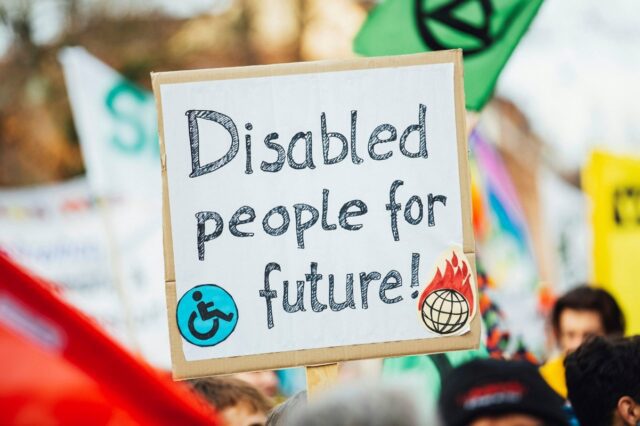
For the disability community, Civil Rights aren’t abstractions; they are essential (File Photo/Unsplash)
There are moments when a community is called not simply to observe, but to respond.
This is one of those moments.
Across Montana, more than 1,000 individuals and 64 organizations have come together to raise their voices in defense of something fundamental: the civil rights of people with disabilities. At the center of this effort is Section 504 of the Rehabilitation Act, a law that, for more than fifty years, has affirmed a simple but transformative principle: that every person, regardless of ability, has the right to participate fully in society.
To understand what is at stake, we must first understand what civil rights are: Civil rights are not abstract legal concepts. They are the conditions that make life in a community possible. They are the guarantees that individuals will not be excluded from education, denied access to healthcare, prevented from working, or isolated from public life simply because of who they are.
They are, in essence, the foundation of belonging.
In the United States, the story of civil rights has never been static. It is a history marked by struggle, by advocacy, and by the persistent effort to bring the reality of our society closer to its ideals. From the earliest constitutional principles to the movements that expanded rights across lines of race, gender, and disability, civil rights have been the means through which the nation has sought to define itself, not as perfect, but as continually striving toward greater inclusion and justice.
Section 504 is part of that legacy.
For generations, it has ensured that individuals with disabilities are not left outside the structures that shape daily life: healthcare, education, housing, employment, and public services. It has made it possible for people to live in their communities rather than be separated from them. It has been affirmed that disability does not diminish a person’s place in society.
Today, those protections are being challenged.
Montana’s participation in a multi-state lawsuit seeking to overturn updated federal regulations under Section 504 has raised deep concern across the disability community. Advocates, organizations, and individuals from every corner of the state are warning that the consequences of this challenge could reach far beyond policy, into the lived realities of thousands of Montanans.
For many, this is not theoretical.
It is the ability to remain in one’s home rather than be forced into an institution.
It is the right to access education, to raise a family, to participate fully in community life.
It is the assurance that disability does not mean exclusion.
Voices across Montana are speaking with clarity and conviction.
Leaders of Centers for Independent Living have emphasized that the infrastructure supporting independent living, transportation, access to services, and community integration depends on the protections that laws like Section 504 provide. To weaken those protections is not simply to change policy; it is to risk undoing decades of progress.
At LIFTT, we see every day what civil rights make possible.
Independence is not a single event. It is built through access to transportation, information, services, and opportunity. It is sustained by the knowledge that individuals have the right to make decisions about their own lives and to participate fully in their communities. And it is something that touches all of us.
Disability is not a distant category. It is part of human experience. It is something that may enter any life through injury, illness, or aging. Civil rights protections exist not for a select few but for all of us across the course of our lives.
What is unfolding now is not simply a legal debate.
It is a question about the kind of society we choose to build.
Do we continue the work of expanding access and inclusion?
Do we affirm that every individual belongs in the community?
Do we protect the principles that have allowed so many to live with dignity and independence?
Across Montana, the answer is being written not only in policy but also in the voices of those who believe that civil rights are essential, enduring, and worth protecting.
This moment will pass.
But the choices made within it will shape the future.
And that future, as always, will depend on whether we continue the work of building a society where independence, dignity, and belonging are not privileges but rights.
About Living Independently for Today & Tomorrow (LIFTT): LIFTT is a Montana 501(c)3 corporation organized as a Center for Independent Living (CIL). With team members based in Billings and Glendive, LIFTT provides aging and disabled members of the community with programs and services that help empower them to break down the physical, bureaucratic, and cultural barriers that prevent them from being fully independent participants in their lives and communities throughout 18 counties in southeastern and south-central Montana: Big Horn, Carbon, Carter, Custer, Dawson, Fallon, Garfield, Golden Valley, McCone, Musselshell, Powder River, Prairie, Richland, Rosebud, Stillwater, Treasure, Wibaux, and Yellowstone. For more information, please visit liftt.org or download our mobile app for your Apple device.
Our Vision: Empowering aging and disabled individuals to LIFTT themselves above the barriers of life.
Our Mission: Living Independently for Today and Tomorrow – LIFTT’s mission is to empower aging and disabled individuals to live independently through education, support, and opportunities.