
This is the third post in a series we are calling “Wednesday Wisdom” Where we take you, our consumers, supporters, and readers inside of LIFTT to give a detailed picture of some portion of our programs and operations. This week, Freda Mook manager of both LIFTT’s Independent Living and Community First Choice Programs discusses the similarities and differences between IL and PCA services and how LIFTT strives to integrate them to best serve our consumers.
Integration of Independent Living and Personal Care Attendant Services – How they are similar, why they are different,
by Freda Mook
Manager of LIFTT’s Independent Living (IL) & Community First Choice (CFC) Programs
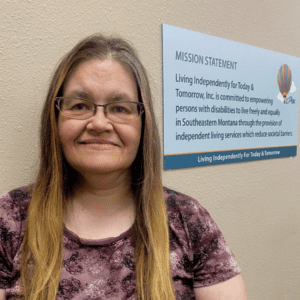
LIFTT Independent Living & Community First Choice Program Manager Freda Mook
As the manager of LIFTT’s Independent Living (IL) and Medicaid Community First Choice (CFC) Programs, I can say that the two programs are simultaneously similar and different. This statement Is not as absurd as it sounds. It is known as a veridical paradox because even though it seems to contradict itself, it is nonetheless true. On the one hand, the IL and CFC programs are similar, analogous, comparable, and complimentary. On the other hand, they are also different, distinct, and unique. They are similar because they are both person-centered. They are different because the work performed by the IL Specialists is not as regulated by policies and procedures as the PCA facilitators’.
The IL and CFC Services are person-centered, meaning that the Consumer receiving care is at the center of the entire planning process. IL Specialists refer to this principle as self-determination, self-help, and self-advocacy. PCA Facilitators are guided and inspired by the Person Centered Planning (PCP) approach, which gives the Consumer/Person choice and control in important areas. PCP is at the center of everything right about health and care delivery to persons with disabilities because it addresses the specific needs of real people. IL Specialists and PCA Facilitators begin their intake process by learning how their Consumer/Person wants to live because that is what they are concerned about considering that this idea is at the core of independent living.
According to the Administration for Community Living (ACL), “Person-Centered Planning (PCP) is a process for selecting and organizing the services and supports that an older adult or person with a disability may need to live in the community. Most importantly, it is a process directed by the person who receives the support.” Therefore, there is no doubt that the principles of PCP apply to both IL and CFC Programs.
The PCP approach makes it possible for LIFTT to integrate both programs, share Consumers/Persons and refer Consumers/Persons to one another. Using the PCP approach, IL Specialists and PCA Facilitators identify the Consumer/Person’s strengths, goals, medical needs, needs for home- and community-based services, and desired outcomes.
The PCP Process aligns with the goal and service planning done in IL Services because it puts the Consumer in the driver’s seat regarding what they want to accomplish in life. PCP is in harmony with the Independent Living philosophy because it recognizes that people with disabilities should have the same civil rights, options, and control over choices in their own lives, as people without disabilities.
The term “Person-Centered Planning” is often used when some of the processes are being discussed and implemented, but there are different procedures in different states. Goal setting with the people we serve is a fluid, ongoing process and can be a rewarding learning experience for both IL Specialists and Consumers.
For many individuals, PCP has meant fun, relaxed, positive meetings. PCP is personalized individual care. It gives the Consumer/Person a chance to pursue their dreams, interests, and goals and enables participation in one’s community. PCP focuses on the whole person, not just the need for care in a single area of life. It allows a person to make meaningful connections, own significant possessions, and pursue happiness and wellness according to their needs and personal goals. It leads to living a barrier-free life.
The IL Program provides less intrusive, less “medically” based services and is not involved in the Consumer’s daily affairs. Still, it does not mean that their involvement is less relevant to the Consumer’s life. Both Departments offer much in the way of life improvement for Consumers, and both departments should work more closely together to ensure that no needs go unmet.
Promoting the integration of LIFTT’s IL and CFC programs has been a dynamic, multi-actor engagement process. It facilitated effective participation by LIFTT’s consumers, IL Specialists, and PCA Facilitators fostering a shared sense of responsibility for the future of independent living in Eastern Montana. This integration process ensures that we all work harmoniously to increase our consumers’ independent living levels.
If you have any questions about the services LIFTT provides through any of these programs, please do not hesitate to contact me at 406-294-5182 or fredam@liftt.org.
About Living Independently for Today & Tomorrow (LIFTT): LIFTT is a Montana 501(c)3 corporation organized as a Center for Independent Living (CIL). With team members based in Billings, and Glendive, LIFTT provides people with disabilities with programs and services that help empower them to break down the physical, bureaucratic, and cultural barriers that prevent them from being fully independent participants in their lives and communities throughout 18 counties in southeastern and southcentral Montana: Big Horn, Carbon, Carter, Custer, Dawson, Fallon, Garfield, Golden Valley, McCone, Musselshell, Powder River, Prairie, Richland, Stillwater, Wibaux, and Yellowstone. For more information, please visit liftt.org or download our mobile app on Apple or Google Play.