
It’s another entry in our “Wednesday Wisdom” series; Where we take you, our consumers, supporters, and readers inside of LIFTT to give a detailed picture of some portion of our programs, services, operations, and related topics. This week, Senior IL Specialst/Glendive Office Manager Jennifer Hawkinson draws from her lifetime in the human service field to provide some information regarding programs and services for youth and young adults with disabilities as they transition to further education or employment following high school.
Services & Resources for Youth with Disabilities
by
Jennifer Hawkinson
LIFTT Senior IL Specialst & Glendive Office Manager
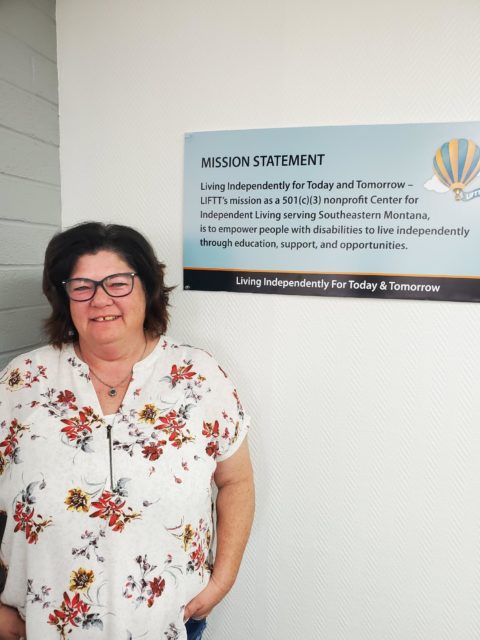
LIFTT Senior IL Specialist/ Glendive Office Manager Jennifer Hawkinson
For youth with a disability, there are options available for them to be not only more independent but to be successful in school and in life.
One resource for youth who need assistance with advocacy issues is the Montana Empowerment Center (MEC). MEC works with Montana families and their children up to young adulthood with disabilities to encourage and educate.
The Individuals with Disabilities Education Act (IDEA) is a law that makes available “a free, appropriate public education to eligible children with disabilities and ensures special education and related services to those children”.
An Individualized Education Plan (or Program) is also known as an IEP. This is a plan or program developed to ensure that a child with an identified disability who is attending an elementary or secondary educational institution receives specialized instruction and related services. The IEP is developed by a team of individuals from various educational disciplines, the child with a disability, family members, and/or designated advocates. Anyone can be invited to an IEP as long as the parent feels the input is for the benefit of the child’s education.
An IEP typically includes the following:
- The involvement and progress of the child with a disability in the general curriculum.
- All related services for which the child qualifies.
- Appropriate educational accommodations are necessary for the child to be successful.
- The child’s present levels of educational performance.
- Measurable annual goals and objectives for the child’s education.
What are 504 accommodations examples?
- preferential seating.
- extended time on tests and assignments.
- reduced homework or classwork.
- verbal, visual, or technology aids.
- modified textbooks or audio-video materials.
- behavior management support.
- adjusted class schedules or grading.
- verbal testing.
What’s the difference? A 504 plan is geared toward ensuring a student has equitable access to a learning environment. An IEP focuses on educational benefits and often includes direct services such as speech or occupational therapy. An IEP is monitored more closely as a 504 is not.
An IEP will not follow a student to college but a college can make academic accommodations if the students need them.
- Register with disabilities services.
- Provide a medical or psychological document describing the disability and how it impacts their daily functioning.
- Most colleges require a dated evaluation within the last three years such as an IEP.
- The student will need to meet with the disability office to discuss what accommodations are needed.
- The student must notify each professor that an accommodation is needed.
- The student must request to use an accommodation during class or testing.
The Workforce Innovation and Opportunity Act (WIOA) is designed to help job seekers access employment, education, training, and support services to succeed in the labor market. There are two groups for the youth. In-school youth are ages 14 to 21 and 25% of all funding goes towards their development and out-of-school youth are ages 16 to 24 and 75% of funding must go to those youth. The difference is that it is believed that in-school youth have resources available whereas out-of-school youth do not. Some of the services that can assist these youth are:
- Paying wages and workman’s comp to gain work experience.
- Purchases include but are not limited to:
- Clothing
- Personal care items
- Internet
- Computer
- Car repair if the value of the car repair does not exceed the value of the car
- Tools of the trade
- Rent
Basically, anything to get the youth to work or through training.
The website MTCIS.intocareers.org is another resource for youth as it offers assessments, college resources, and employment assistance such as resumes.
Pre-Employment Transition Services (Pre-ETS) are activities that provide an early start at job exploration for students with disabilities ages 14-21 to assist with transitioning from school to postsecondary education or employment. Vocational Rehabilitation and Blind Services (VRBS) works with schools and other organizations across the state to deliver Pre-ETS services. Pre-ETS services focus on
- Job exploration counseling
- Work-based learning experiences
- Counseling on post-secondary programs
- Workplace readiness training
- Self-advocacy
Youth transition services through LIFTT can also assist youth. Youth transitions through LIFTT can assist youth to learn life skills that will help them with the rest of their lives. Some examples of life skills are:
- Learning how to budget.
- Acquiring employment.
- How to rent an apartment.
- How to grocery shop.
- How to do laundry and other household chores.
- How to open a bank account
- How to balance a bank account
- How to pay bills.
- ETC
There are many services available to youth and their parents but the struggle is knowing what is available and what a parent’s rights are when it comes to advocating for their child. If you would like more information about the services available or have specific questions please contact LIFTT at (406) 259-5181 (Billings) or (406) 948-8500 (Glendive) and connect with an Independent Living Specialst.
About Living Independently for Today & Tomorrow (LIFTT): LIFTT is a Montana 501(c)3 corporation organized as a Center for Independent Living (CIL). With team members based in Billings and Glendive, LIFTT provides people with disabilities with programs and services that help empower them to break down the physical, bureaucratic, and cultural barriers that prevent them from being fully independent participants in their lives and communities throughout 18 counties in southeastern and southcentral Montana: Big Horn, Carbon, Carter, Custer, Dawson, Fallon, Garfield, Golden Valley, McCone, Musselshell, Powder River, Prairie, Richland, Stillwater, Wibaux, and Yellowstone. For more information, please visit liftt.org or download our mobile app on Apple or Google Play.